
A Minimally Invasive Treatment for Calcific Tendinitis
In addition to performing hundreds of image guided procedures each year using orthobiologics for regeneration, Dr. Lawinski uses ultrasound imaging to guide a specific and innovative treatment for calcific tendinitis, which is a relatively common and painful condition caused by calcium deposits on the tendons.
What Is Calcific Tendinitis?
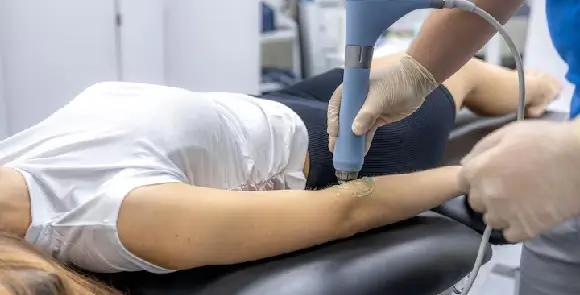
When calcium accumulates on a tendon — the strong tissue that connects the muscle to the bone — it does not always cause pain. However, calcium deposits that are large or inflamed can be extremely painful, a condition called calcific tendinitis. Calcific tendinitis occurs most often in the shoulder tendons and can occur very suddenly.
How Barbotage Treats Calcific Tendinitis
If you are diagnosed with calcific tendinitis and are not satisfied with standard and traditional treatments such as rest, ice and ibuprofen to relieve pain and inflammation, you may be a good candidate for an outpatient procedure called barbotage which is done under ultrasound guidance to precisely locate bones, muscles, nerves, and tendons and deliver treatment directly, avoiding the need for open surgery and long recoveries.
In a barbotage procedure, our doctor uses ultrasound imaging to locate the calcium deposits and then breaks them up so that they can be absorbed into your body. In some cases, saline fluid is injected, which flushes the area out and allows the removal of some of the calcium. Barbotage involves a local anesthetic and very little recovery time.
What Will Happen During the Procedure?
When you arrive at our office, you will be escorted to the procedure room and asked to sit on the examination table. We will clean your shoulder or area of the body that will receive the injection and apply a local anesthetic to help prevent discomfort.
We will then apply a small amount of warm gel, which is used with ultrasound to prevent air pockets from forming between the transducer (wand) and skin. The sonographer will then glide the transducer over your skin to capture images of the tendon, which the transducer then sends to a computer.
Using the images, our physician will pinpoint the precise location of the calcium deposit, insert a needle, and move the needle to break up the calcium into little pieces, some of which will be absorbed back into the body. You may feel some pressure or discomfort from the injection.
Frequently Asked Questions
What is calcific tendinitis?
Calcific tendinitis is a condition caused by calcium deposits building up on a tendon. It occurs most often in the shoulder tendons, can develop suddenly, and large or inflamed deposits can be extremely painful.
What is barbotage?
Barbotage is a minimally invasive, ultrasound-guided outpatient procedure that locates calcium deposits on a tendon and breaks them up so they can be absorbed by the body, avoiding open surgery and long recovery times.
Is barbotage painful?
The procedure uses a local anesthetic to help prevent discomfort, though you may feel some pressure or discomfort while the needle breaks up the calcium deposit.
How long does the procedure take?
The entire barbotage procedure takes about 60 minutes.
How successful is barbotage at relieving calcific tendinitis?
Published studies report success rates generally ranging from roughly 60% to 85%, with better outcomes for patients treated earlier in the course of their symptoms. Some patients experience lasting relief after one treatment, while others need a repeat procedure or an additional intervention if symptoms persist; your physician can discuss what’s realistic for your specific case.
What is recovery like after barbotage, and how does it compare to surgery?
Most patients resume light activity within a few days, though published guidelines note that full tendon healing can take several months even as pain relief is often felt much sooner. Barbotage is generally lower-cost than arthroscopic surgery and doesn’t require an operating room, though your physician may still recommend surgery if the deposit is too large to treat this way or if symptoms don’t improve.
Am I a candidate for barbotage?
If you have been diagnosed with calcific tendinitis and are not satisfied with standard treatments such as rest, ice, and ibuprofen, you may be a good candidate. Not every patient with calcific tendinitis is an appropriate candidate; call the clinic to discuss your specific situation.
Is barbotage available on the Big Island, or do I need to see a specialist in Honolulu?
Barbotage is available locally at Hawaii Island Stem Cell Therapy and Regenerative Medicine, 15-3039 Pahoa Village Rd, Pahoa, HI 96778, so patients from Hilo, Kona, and across the Big Island can be treated for calcific tendinitis without traveling to Oahu.
This information is provided for educational purposes only and is not a substitute for professional medical advice, diagnosis, or treatment. Individual results vary, and no specific outcome is guaranteed. Please consult with Dr. Lawinski or another qualified physician to discuss whether barbotage is appropriate for you.

